
How to remove Liquid Nails adhesive
A bond that outlasts the project is the point, which makes removal the hard part. The wet bead comes off easily; the cured bead has to be softened before it is scraped. Here is what works on each surface.
While it is still wet
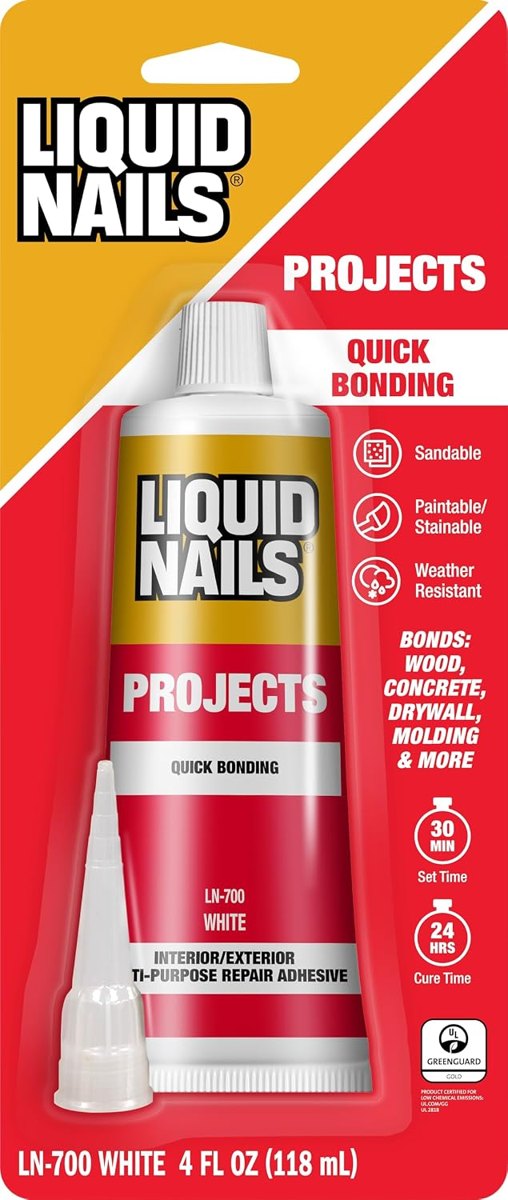
Latex formulas (Interior Projects, Paneling & Molding, Projects & Foamboard, drywall adhesives, Super Caulk) wipe off with a damp rag and clean up with water. Solvent formulas (Heavy Duty, Extreme, Subfloor & Deck, Landscape Block) wipe off with a rag and mineral spirits. Fuze*It wipes off with mineral spirits or isopropyl alcohol. Do it within the working time; after that the bead is set.
Cured adhesive on wood, drywall and tile
- Heat: a heat gun or hair dryer on high softens cured construction adhesive in a minute or two; scrape with a plastic putty knife while it is warm.
- Citrus or soy-based remover: apply, wait the time on the can, scrape. Test paint and finishes first.
- Mineral spirits soften solvent-based residue after the bulk is scraped.
- On drywall, expect to take some paper with the adhesive; skim coat and sand.
Concrete and masonry
Cured adhesive on concrete comes off mechanically: a wide chisel or a floor scraper after warming with a heat gun, or a grinder with a cup wheel for a floor that is getting a new covering. Soften stubborn ridges with citrus remover overnight.
Skin and hands
Wet adhesive washes off with soap and water (latex) or a little mineral spirits followed by soap (solvent). Cured adhesive on skin is not dangerous; rub petroleum jelly or cooking oil into it, wait, and it rolls off over a day or two. Do not use a knife on skin.
Caulk guns and tools
Pull the cartridge, wipe the rod and the frame with mineral spirits before the adhesive cures. Cured adhesive on the gun chips off with a screwdriver. A nozzle plugged with cured adhesive can be cut back 1/4 in. to a fresh opening; the cartridge underneath is still good.
Separating bonded pieces
A cured Heavy Duty joint is often stronger than the wood around it, so prying splits the lumber. Run a wire or an oscillating tool with a flush-cut blade through the bead, then clean each face as above. On a mirror bonded with Fuze*It, piano wire worked behind the glass cuts the bead without breaking the mirror.
Removing heavy duty construction adhesive: what to expect
Heavy duty construction adhesive is designed for a heavy-duty bond that outlasts the job, so removing heavy duty construction adhesive is a test of patience rather than strength. This guide covers the power tools and the hand tools, the hours it takes, and the tough spots: cured drops on a floor, a gap-filling bead on drywall, and a nozzle that cured solid. The tips above cover the surfaces a repair usually meets; the common thread is heat, time and the right solvent for the formula. A cured Liquid Nails Heavy Duty bead on wood or drywall softens with a heat gun and scrapes off in strips; drops of construction adhesive on a floor come up with a plastic scraper after a citrus remover has had an hour; a cured bead on concrete needs a chisel or a grinder. Work in a ventilated space, test the remover on a hidden spot, and expect to touch up paint.
To avoid the job next time: cut the nozzle to the desired bead size and not larger, apply the construction adhesive to one surface only, and wipe squeeze-out while it is wet, which takes seconds. Keep the gap-filling bead inside the joint, and store the cartridge capped so the nozzle does not cure solid. Indoor latex formulas clean with water; the solvent-based heavy-duty formulas and Fuze*It clean with mineral spirits. Outdoor beads that have cured through a few seasons are the toughest, and the ASTM standards our construction adhesives meet are the reason: the bond was built to hold through temperature, water and time.