
How long does Liquid Nails take to dry?
Dry and cure are two different clocks. Dry is when the bead no longer moves; cure is when the bond reaches full strength. The second clock is the one that decides when the brace comes off.
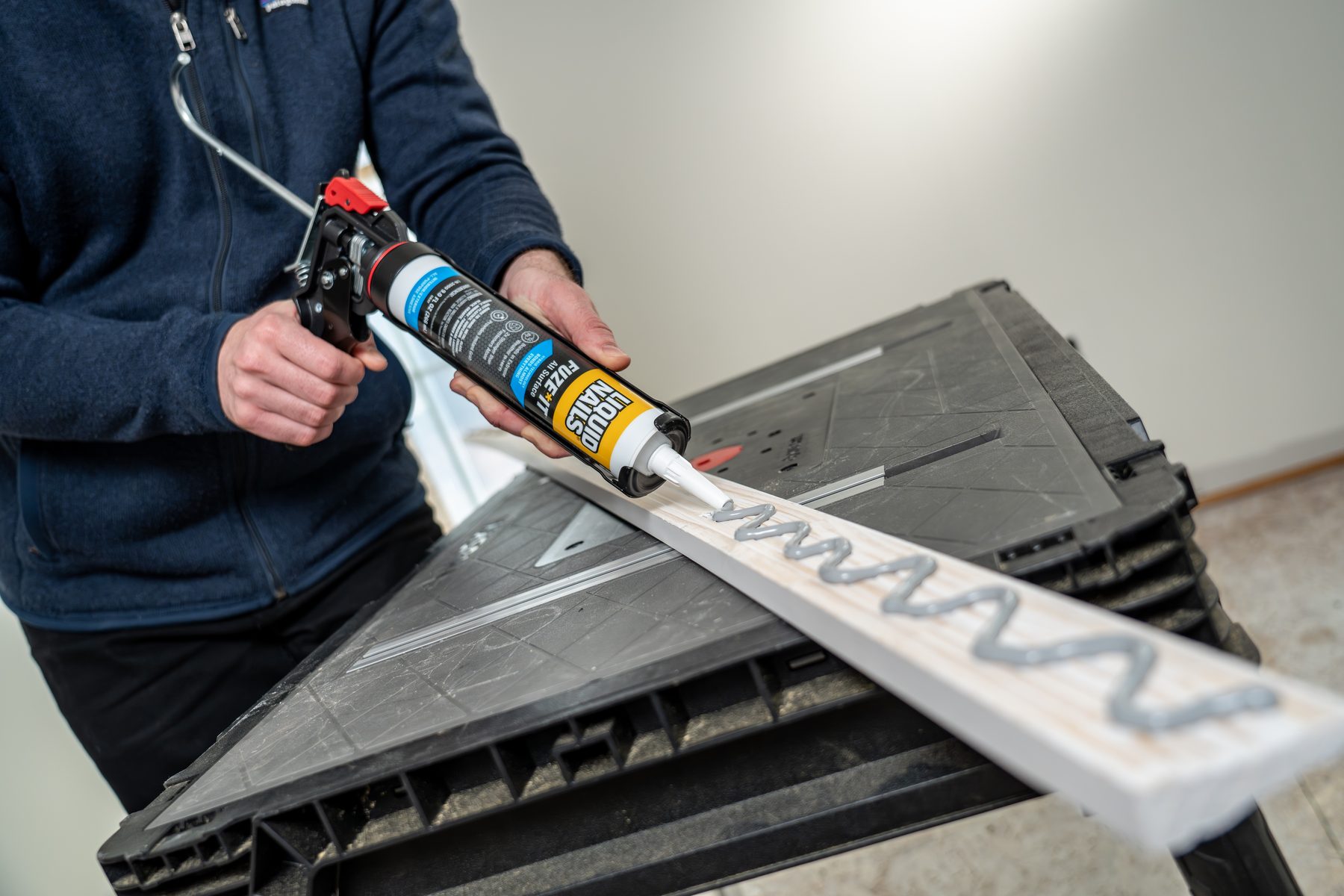
Four stages of a bead
- Grab: within minutes the adhesive holds a light piece in place. Fuze*It and Paneling & Molding have the strongest initial grab.
- Working time: 10 minutes for Heavy Duty, Extreme and Fuze*It, about 20 minutes for Paneling & Molding; the window to adjust the piece.
- Set: 24 hours of bracing or fasteners while the bond builds strength.
- Full cure: from 24 hours for Fuze*It up to 7 days for a thick bead between two non-porous surfaces.
Times by formula
- Heavy Duty (LN-903): grab in minutes, 10 minute working time, brace 24 hours, full cure up to 7 days.
- Extreme Heavy Duty (LN-907): same schedule, and it keeps curing in heat and cold where others stall.
- Fuze*It (LN-2000, LN-547): up to 10 minutes working time, full cure in 12 to 24 hours.
- Subfloor & Deck (LN-902, LN-602): instant holding power, fasten immediately, walk on it the next day, full cure 7 days.
- Interior Projects, Projects & Foamboard, Paneling & Molding: 20 minute working time, 24 hour brace, cure 7 days; water-based, so they cure slower in humidity.
- Tub Surround (LN-715): brace 24 hours, caulk the seams after 24 hours, water after 48 to 72 hours.
- Landscape Block, Concrete & Mortar Repair: 24 hours before load, 7 days full cure.
- Caulks (Super Caulk, Multi-Purpose): skin in 30 minutes, paintable in 1 hour, full cure 24 to 48 hours.
- Clear Seal and silicone sealants: tack-free in an hour, waterproof in 24 hours.
What slows the cure
Cold slows every formula; below 40 degrees F most of them stall, which is why Subfloor & Deck and Extreme exist. High humidity slows latex formulas because the water in them has nowhere to go. A thick bead cures slower than a thin one. Two non-porous surfaces trap moisture; one porous surface lets it out. Leave the brace longer in any of those cases rather than testing the joint early.
How to tell it has cured
Squeeze-out at the edge of the joint turns from paste to firm rubber and then to a solid that takes a fingernail without denting. For a structural piece, wait the full time on the label regardless of how the edge feels; the center of the bead cures last.
Construction adhesive cure time, in plain words
The dry time of a construction adhesive depends on the formula, the temperature, the humidity and the materials. A heavy duty construction adhesive like Liquid Nails Heavy Duty dries to the touch in about an hour, holds a piece after 24 hours and reaches full strength in up to 7 days. A hybrid construction adhesive like Fuze*It cures with moisture from the air and is fully cured in 12 to 24 hours, which makes it the fastest construction adhesive we make for mixed materials and for PVC, metal and glass. A latex construction adhesive for drywall, paneling or foam board needs the water in it to escape, so it cures slower in humidity and between two non-porous surfaces.
Three practical rules. First, the construction adhesive is not holding the piece until it cures, so use fasteners, tape or bracing for the first 24 hours; the fast grab of Fuze*It and Paneling & Molding only helps on light pieces. Second, apply in the temperature range printed on the tube; a cold cartridge guns poorly and a cold bead cures slowly, so keep the construction adhesive in the cab and the gun warm. Third, a thick bead takes longer than a thin one, so remove excess squeeze-out while it is wet with mineral spirits or water and keep the bead to 1/4 in. The ASTM C557 and D3498 standards that construction adhesives are tested against measure strength after a full cure, which is the number on the label; your joint reaches it on the same schedule.
If you are choosing between a premium heavy duty construction adhesive and wood glue for an indoor project, the cure times are similar but the uses are not: wood glue needs tight, clamped joints and dries hard; construction adhesive fills gaps, stays flexible and bonds wood to drywall, concrete and subfloor panels. For the strongest results on an exterior job, Extreme Heavy Duty keeps curing in heat and cold where other construction adhesive formulas stall.




